ISHVAR
(Information System of Hill Springs for Vulnerability Analysis and Rejuvenation)
(Information System of Hill Springs for Vulnerability Analysis and Rejuvenation)
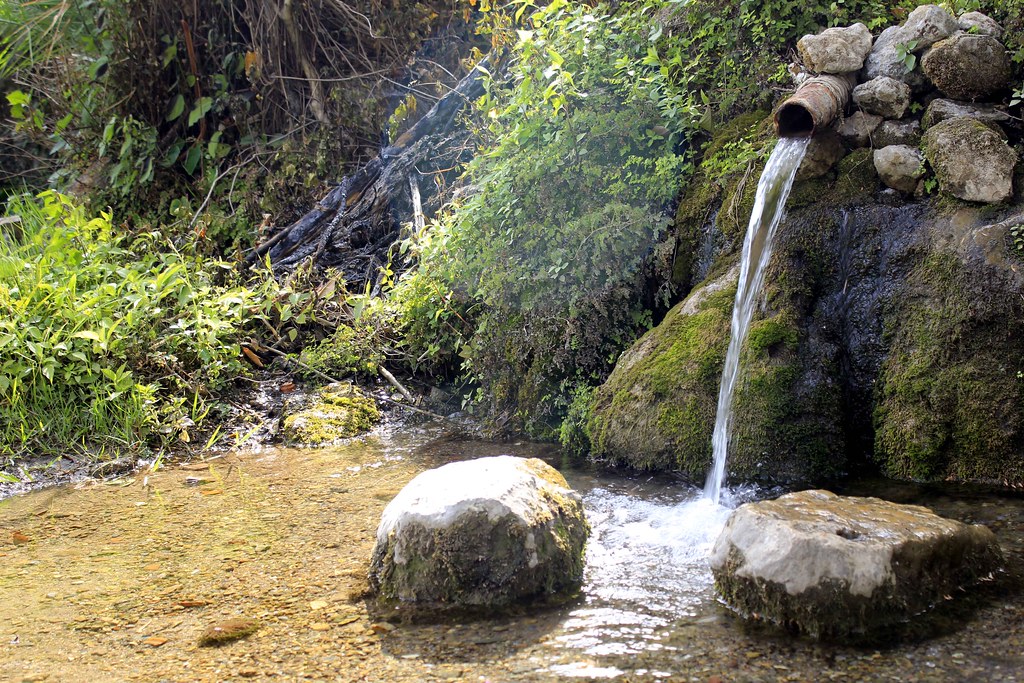 Springs, the visible manifestation of groundwater on the earth’s surface, serve as the primary source of water for millions of inhabitants in the mountain ranges
across the India. A gross estimate of nearly 200 million Indians depends on spring water –mainly in the Indian Himalayan Region, Western Ghats (Sahyadri mountain range, traversing the states of Maharashtra, Goa, Karnataka,
Kerala, and Tamil Nadu), Eastern Ghats (Northern Odisha, Andhra Pradesh, and Tamilnadu) and Central India (Satpura and Vindhyas mountains). Springs are a vital source of the mountainous ecosystem, which is the source
of several major rivers that are crucial for the agricultural and industrial growth of the nation. Additionally, springs are one of the most cost-effective ways to provide relatively pure water in entire stretch of
Indian Himalayan Region (IHR) as rivers are flowing in the deep valley and glacier are far flung, so water from these two sources is economically not feasible.
Springs, the visible manifestation of groundwater on the earth’s surface, serve as the primary source of water for millions of inhabitants in the mountain ranges
across the India. A gross estimate of nearly 200 million Indians depends on spring water –mainly in the Indian Himalayan Region, Western Ghats (Sahyadri mountain range, traversing the states of Maharashtra, Goa, Karnataka,
Kerala, and Tamil Nadu), Eastern Ghats (Northern Odisha, Andhra Pradesh, and Tamilnadu) and Central India (Satpura and Vindhyas mountains). Springs are a vital source of the mountainous ecosystem, which is the source
of several major rivers that are crucial for the agricultural and industrial growth of the nation. Additionally, springs are one of the most cost-effective ways to provide relatively pure water in entire stretch of
Indian Himalayan Region (IHR) as rivers are flowing in the deep valley and glacier are far flung, so water from these two sources is economically not feasible.
However, climate change, deforestation, and
unsustainable development practices are putting immense pressure on these springs. This rapid growth led to accelerated urbanization eventually causing the damage to recharge zones and degradation of water quality of
the springs. Furthermore, population surge has placed significant stress on these vital water sources. As a result, over the past few decades numerous springs have either dried-up or became seasonal. In these circumstances,
fetching water from local springs that have been flowing for centuries has become a full-time occupation for the mountain people, particularly women and children to meet their daily needs. Reduced access to water, in
turn, impacts health, hygiene, and sanitation and limits livelihood options as well. Thus, springs form the lifeline for a larger segment of the mountainous population affecting their survival and sustenance. Despite
the critical role they play, springs are in crisis.
Adopting sustainable development practices and protecting the mountainous ecosystem is essential to ensure its long-term survival and the well-being of millions
of people who depend on it. Therefore, springshed management to protect and rejuvenating the springs has become a pressing need, necessitating scientific studies that complement local knowledge of this invaluable resource.
Thus, the need to identify, conserve and protect the recharge areas of springs becomes important not just for local sustainability but also for the sustenance of our river systems.
However, increasing population and unplanned development have adversely affected the recharge processes and resulted in depletion of this prime water resource in the entire Himalayan region. Furthermore, depletion of these springs is also exacerbated by rising air temperatures, marked decline in winter rainfall and in general, the erratic and torrential rainfall that has replaced the monsoon drizzles of yore. It has been estimated that less than 15% of the rainwater is able to percolate down to recharge the springs, while the remaining flows down as runoff, often causing floods. It is believed that nearly half of the perennial springs in IHR have already dried up or have become seasonal and tens of thousands of villages are currently facing acute water shortage for drinking and other domestic purposes. In such a circumstance, women and children are forced to travel longer distances to fetch a head-load of water, which increases their drudgery, while sacrificing their valuable time to carry-out other works essential for livelihood. Reduced access to water in turn impacts health, hygiene, sanitation and limits the livelihood options as well.
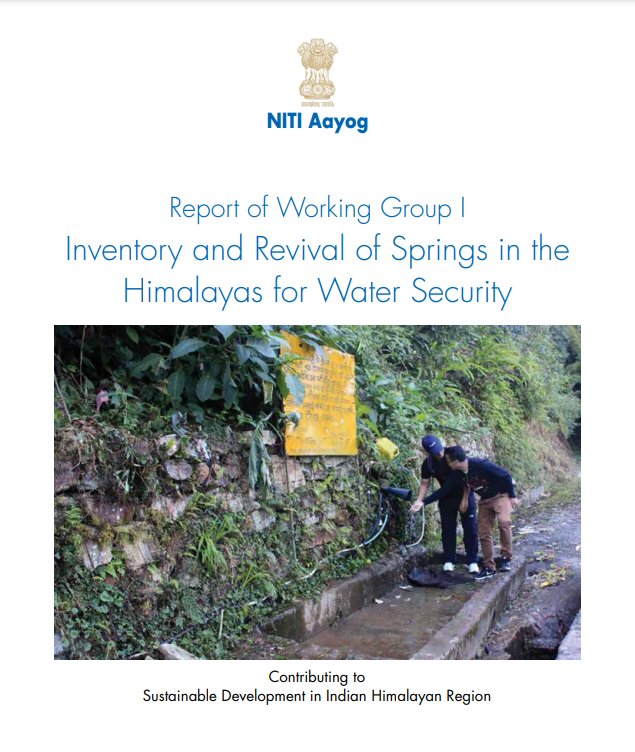
Work done on springs till now by different research organizations, universities and NGO’s lie scattered and very localized, and data is collected for short durations, discontinued as the project come to an end. Due to such practices, a systematic database/inventory on springs as that existing for rivers and groundwater could not be generated in the country. Lack of basic information/inventory on springs is the major hurdle due to which these vital water resources could not be the part of our National Water Policy. Furthermore, non-availability of basic data - even maximum and minimum discharges - discourages the scientist/researcher from choosing vulnerable springs for formulation of new research proposals, while hindering state implementing agencies from formulating DPRs for fulfilling local water demand. Of late, the NITI Aayog took stock of the drying of springs in the entire stretch of Indian Himalayan Region (IHR) and constituted a Working group on "Inventory and Revival of Springs of Himalaya for Water Security", one of its five Working Groups for sustainable development in the IHR.
 In the mountainous areas of Himachal Pradesh, most villages are located at high altitudes, mainly on ridges as scattered hamlets. Thus, people of these villages
are at a great disadvantage for accessing water, as most of the streams originating in the Himalaya flow in the deep valleys, making them inaccessible. In such a situation, natural water springs or traditional water
resources (locally known as Baori, khatri, Naun, panihar, Chharedu in the State) are the only dependable sources of water. It is believed that nearly half of the perennial springs throughout the mountainous areas
has already dried up or has become seasonal, forcing villagers to move wherever water moves. Both natural and anthropogenic factors are believed to be responsible for depletion of quantity (spring flow) and deterioration
of quality of spring water in the region.
In the mountainous areas of Himachal Pradesh, most villages are located at high altitudes, mainly on ridges as scattered hamlets. Thus, people of these villages
are at a great disadvantage for accessing water, as most of the streams originating in the Himalaya flow in the deep valleys, making them inaccessible. In such a situation, natural water springs or traditional water
resources (locally known as Baori, khatri, Naun, panihar, Chharedu in the State) are the only dependable sources of water. It is believed that nearly half of the perennial springs throughout the mountainous areas
has already dried up or has become seasonal, forcing villagers to move wherever water moves. Both natural and anthropogenic factors are believed to be responsible for depletion of quantity (spring flow) and deterioration
of quality of spring water in the region.
The demand for water in the rural areas is much higher than in urban areas as a majority of the population of Himachal Pradesh, live in rural areas. Furthermore,
there is an imbalance between supply and demand for water, particularly among the poor and weaker sections of society, and traditional sources (normally springs) of water play a significant role in bridging this
gap. There are 10,512 traditional sources of water for drinking water in rural habitats of Himachal Pradesh (Survey of status of drinking water in rural habitats, 1991-93). Chamba district, a mountainous part of
Ravi River catchment alone is home for about 2,598 traditional water sources, which is maximum among all districts of the State. According to Himachal Pradesh Human Resource Development Report (2002), water demand
for the population of Chamba district is projected to increase from 36.53 mld (2001) to 58.04 mld (2021). About 85% of this total water demand is from the rural areas that are largely dependent on traditional water
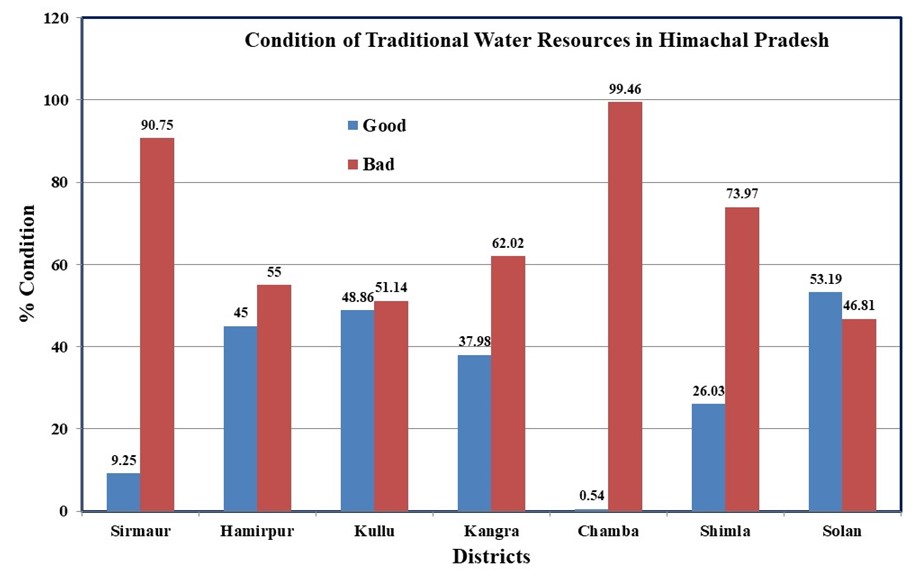
resources. HP State Council for Science, Technology and Environment carried out a survey in 169 Panchayats of seven districts in the State of Himachal Pradesh on traditional water sources that clearly showed there
were only 30% water sources in good working condition and recharging properly throughout the year, while 70% sources were not in proper working condition and going to dry up in near future. In Chamba district, less
than 1% sources were found working well, while more than 99% were in poor condition.
Keeping in view of the importance of traditional water resources in sustaining the water demand of the State, the Planning
Commission (now NITI Aayog), Government of India gave emphasis on creation of a traditional water resources cell in Himachal Pradesh for development and proper care of traditional water resources in view of changing
climate and increasing anthropogenic activities.
Therefore, it is the need of the hour to map these traditional water resources for their protection and proper management to maintain both quality and quantity
in time and space. With this motive, a Purpose Driven Study (PDS) entitled “Web GIS based spring inventory for vulnerability assessment and hydro-geological investigation of selected springs for sustaining local
water demand in Ravi catchment of Himachal Pradesh” has been initiated by Western Himalayan Regional Centre (WHRC), Jammu, one of the six regional centres of National Institute of Hydrology, Roorkee in August, 2017
under the aegis of National Hydrology Project (NHP), Department of Water Resources, River Development and Ganga Rejuvenation, Ministry of Jal Shakti, Govt. of India. Himachal Pradesh Irrigation & Public Health Department
is the supporting department from the state in this Purpose Driven Study (PDS).
The broad objective of initiating this spring based project is setting up of a web-database which will not only facilitate data on springs to government departments, NGOs, CDOs and individuals for effective management of their water related programmes,
but also the baseline data for research institutes for focusing their research projects to develop better understanding of hydro-geology of Himalayan springs. Moreover, this database will help to take stock of the
magnitude of the problem (drying of springs, quality of water from springs) in space and time. Furthermore, development of protocol/adaptive measures for sustaining the vulnerable springs in Western Himalayan Region
in particular and in Indian Himalayan Region (IHR) in general is also another objective of the study. Another objective of the project, viz. the creation of para-hydrogeologists through exposure and informal training
to community members having inherent understanding of spring flow behaviour, will help other villages to identify their spring-sheds and manage their spring waters for ever growing water demand.
Following are the specific objectives of the PDS:
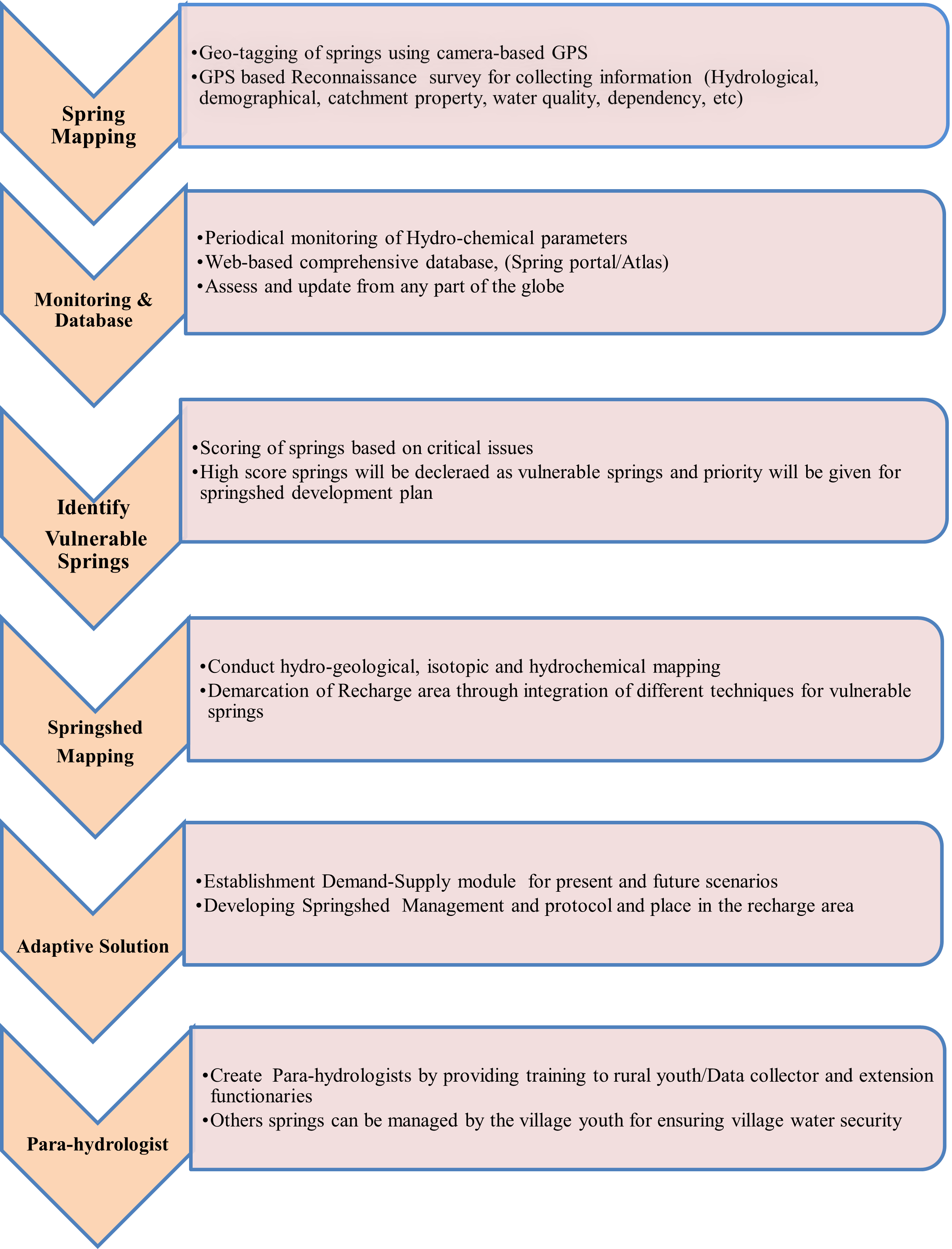
A six-step methodology has been adopted for the holistic development of the springs of the Ravi River catchment of Himachal Pradesh.
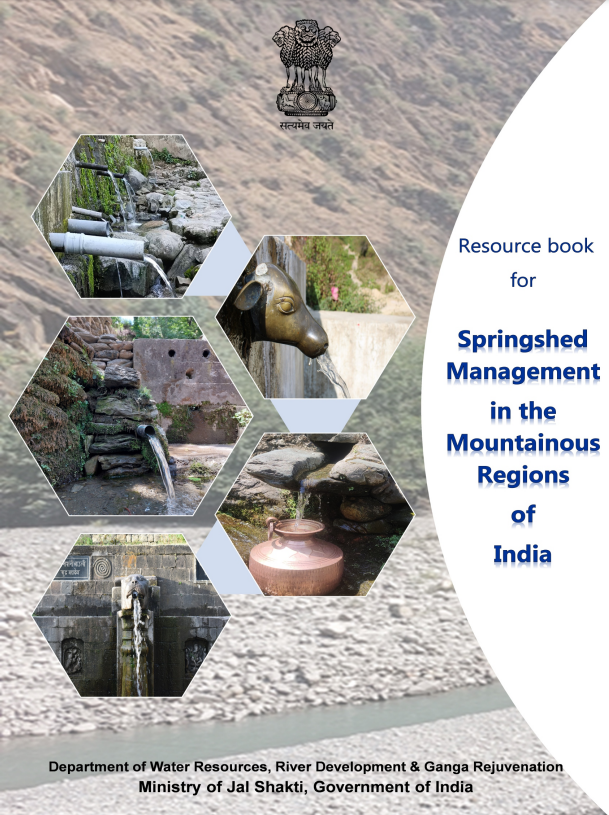
DOI: 10.62916/nih.b.2024.0001 ISBN: 9789334037418
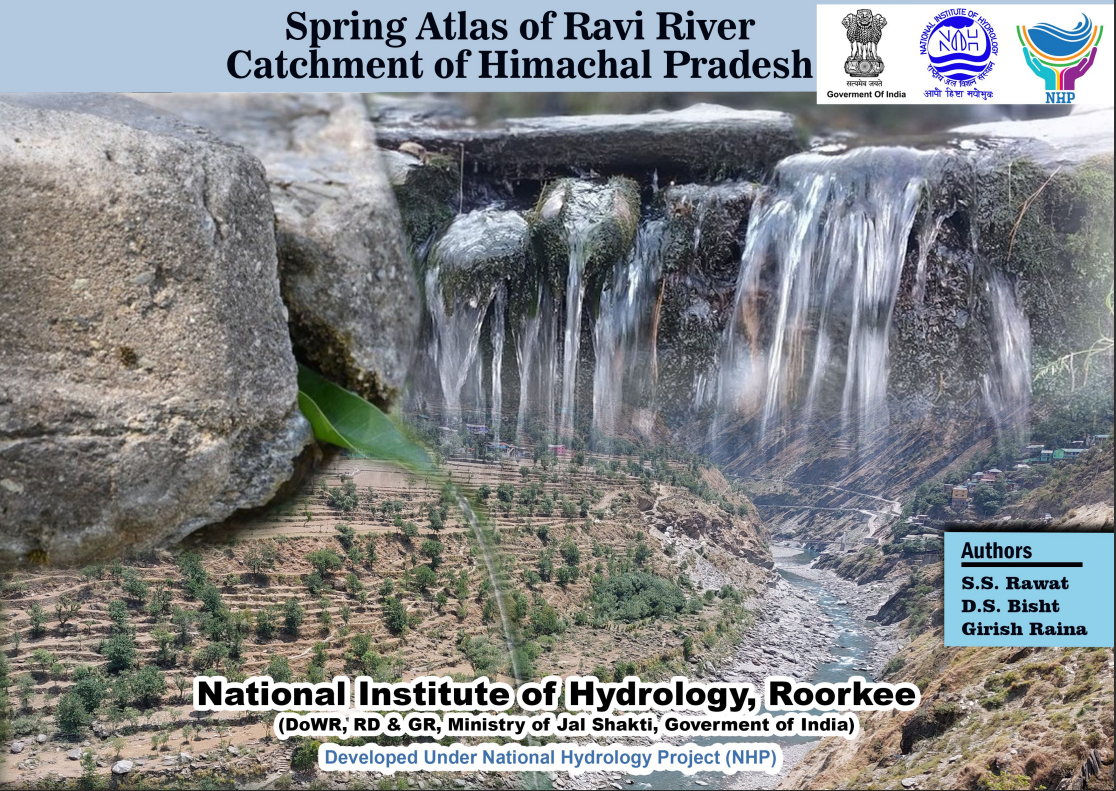
DOI: 10.62916/nih.a.2024.0002
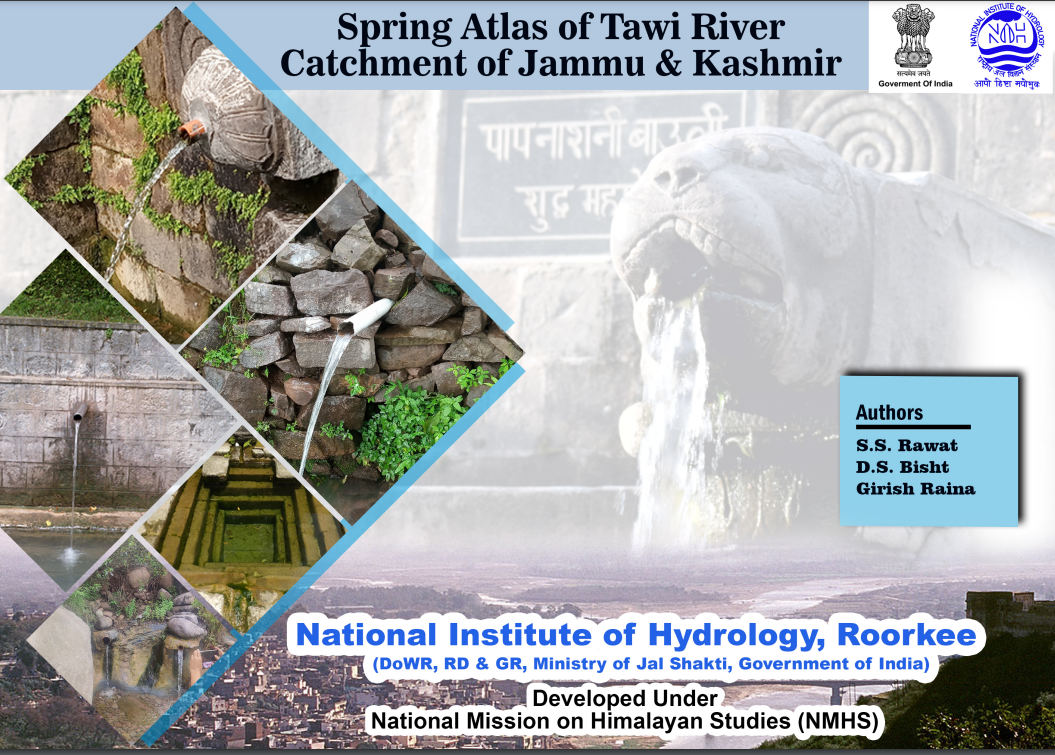
DOI: 10.62916/nih.a.2024.0001
(On click the brief information about the NHP and its Objectives, aims, achievement, target set for the country)
Brief about NIH and the person who actually contributed in the journey of development of this portal